Overview
Commercial electrical work does not price like residential, and most flat rate books never admit it. The same receptacle takes twenty minutes in an open warehouse and ninety minutes above a hard ceiling in an occupied office at nine at night. A book with one price for that service is wrong twice: it loses money on the hard one and it loses the bid on the easy one.
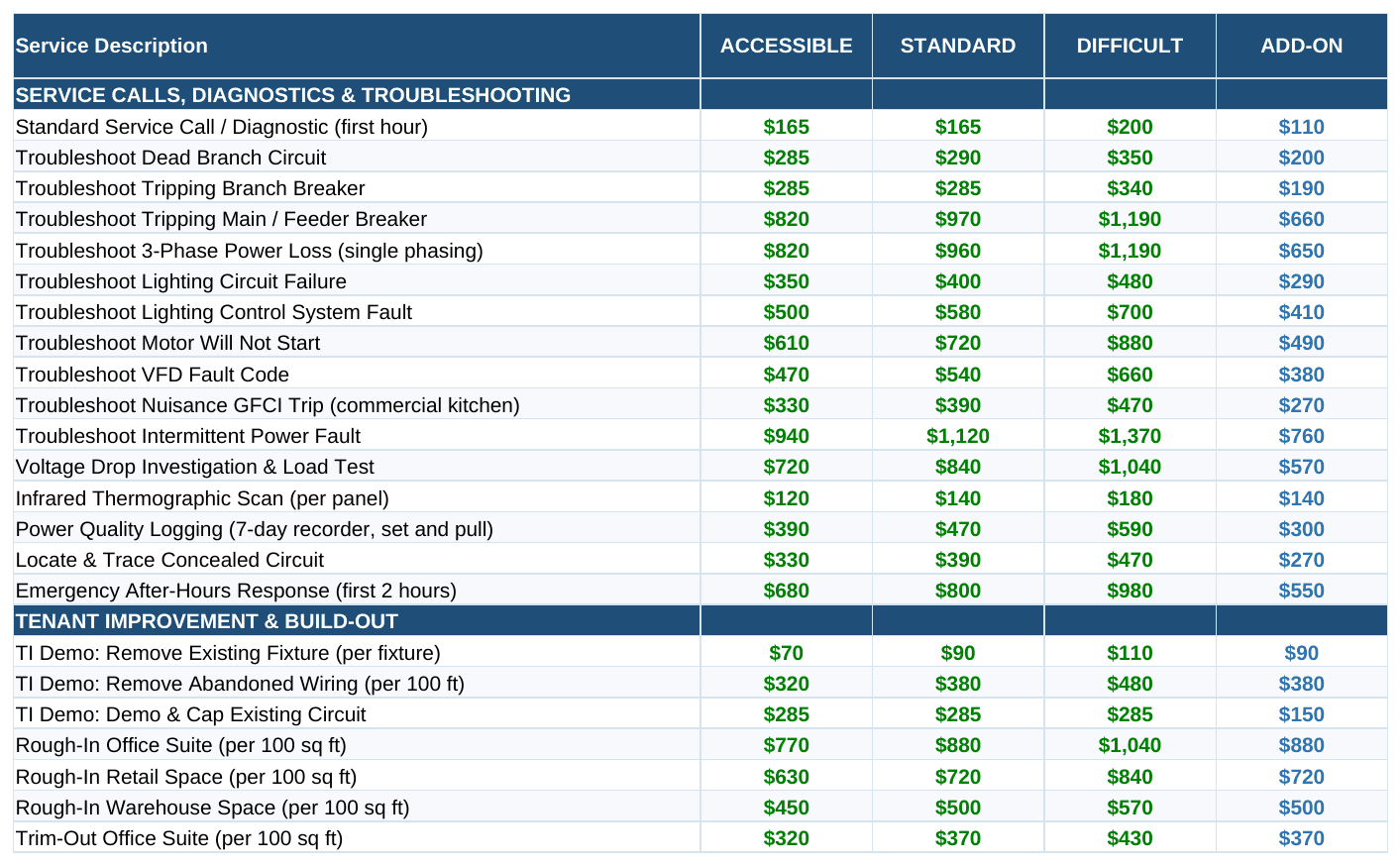
This book prices by how hard the work actually is. Every one of the 373 services carries four prices across 26 categories: accessible, standard, difficult, and an add-on price for when the tech is already on site for something else.
What makes commercial different
The residential book uses good, better and best, because a homeowner is choosing between options. A facility manager is not choosing between options. He has a failed piece of equipment and a building to run, and what moves the price is access, voltage, risk and the hour of the day.
- Access tiers. Accessible is open ceiling under ten feet. Standard is lay-in ceiling and ladder work in an occupied building. Difficult is hard ceiling, lift required, twenty feet and above, or tight and hazardous access.
- 277/480V throughout. Not a residential book with commercial words in it. Three-phase, busway, switchgear, VFDs, transfer switches and tenant improvement are priced as their own categories.
- A hazard premium that is separate from access. Routine de-energized work, elevated work at 277/480V, and high risk work on switchgear and energized cutovers each carry their own factor.
What is inside
Eight tabs. One Excel file, no subscription.
- Flat Rate Price Book, 373 services in 26 categories, four prices each
- Settings, the dozen numbers that drive every price in the book
- Cost Breakdown, the hours, material and margin behind every line. Not for customers
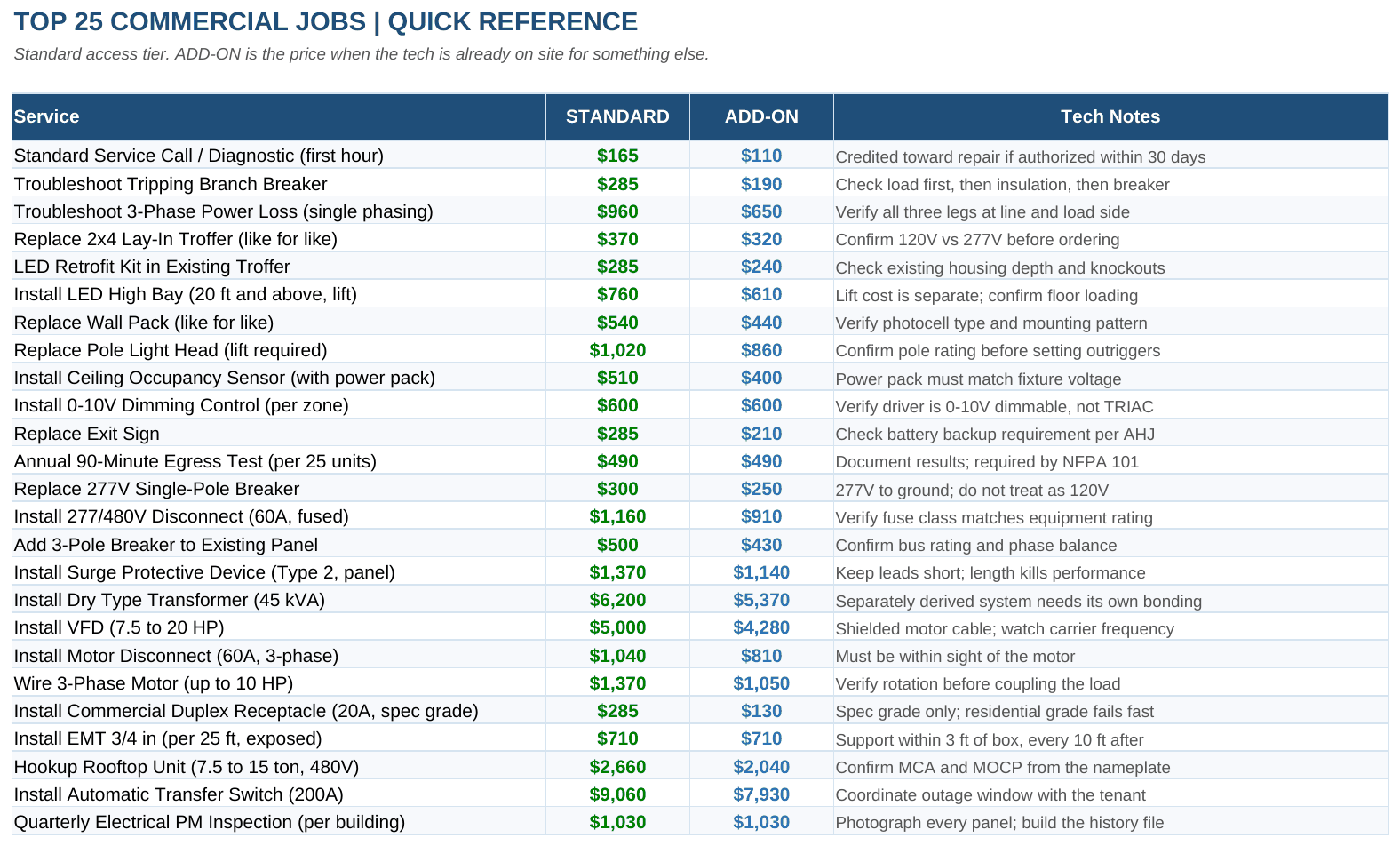
- Quick Reference, the top 25 commercial calls on one page with tech notes
- While On Site, the related work to check and quote while you are already there
- Shift Rate Card, what the same job costs at four different hours of the day
- Quantity Break Calculator, unit pricing that drops as the count goes up
- Scope & Terms, the inclusions and exclusions to attach to every quote
It uses your numbers, not mine
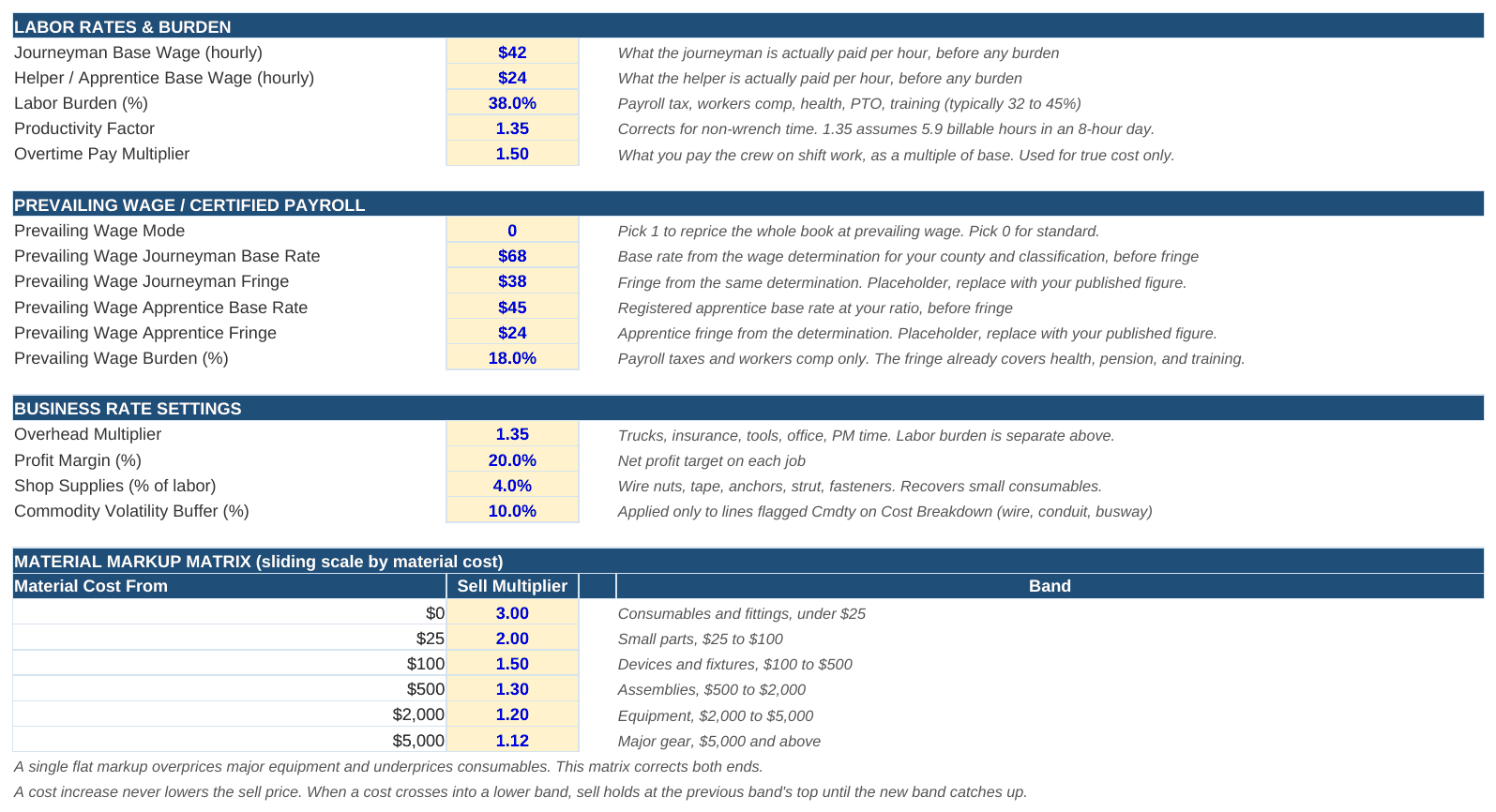
The book ships calibrated to Philadelphia metro 2026 wages and supplier pricing, which is where I work. That calibration is a starting point, not the product. Change the yellow cells on the Settings tab and all 373 prices rebuild on your market.
What you set: journeyman and helper wage, labor burden, productivity factor, overhead multiplier, profit margin, shop supplies, your trip charge and your minimum job charge. The blue cells calculate from those and you never touch them.
Prevailing wage, as a switch
If you touch public work, schools, municipal buildings or anything with certified payroll, you already know the problem: the whole book is wrong the moment you bid a prevailing wage job, because your labor cost is not your labor cost any more.
Set Prevailing Wage Mode to 1 and the entire book reprices on the base rate and fringe from your wage determination, with burden recalculated to payroll taxes and workers comp only, because the fringe already covers health, pension and training. Set it back to 0 and you are on your standard rates again. Same file, two rate structures.
The material markup matrix
A single flat markup is wrong at both ends. Triple on a box of wire nuts is fine. Triple on a forty-five kVA transformer loses you the bid to somebody who marked it up twelve percent.
So material runs on a sliding scale across six cost bands, from 3.0 on consumables under twenty-five dollars down to 1.12 on major gear over five thousand. There is also a ratchet in it: when a cost crosses into a lower band, the sell price holds at the previous band's top until the new band catches up, so a cost increase can never produce a lower price. That is the kind of thing you only find out you need after it bites you.
Shift work, priced properly
Occupied buildings mean night work, and night work is where commercial service either makes its margin or gives it away. Four service windows, each with its own labor factor, and the premium lands on labor only. Material prices the same at two in the morning as it does at two in the afternoon, which matters because a purchasing department will catch it if it does not.
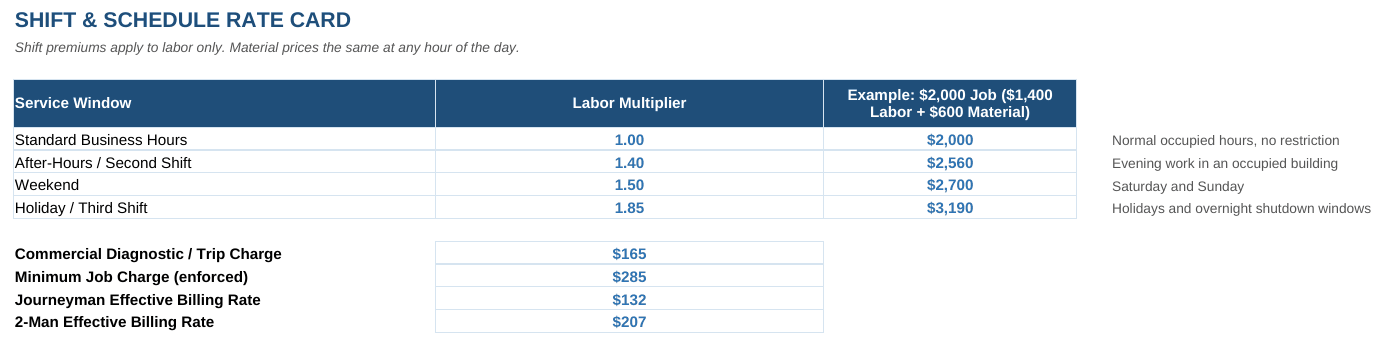
The shift calculator stacks the window against the access tier and the hazard premium, and where a line already carries an after-hours premium in its name it uses whichever factor is higher, so you never charge the premium twice.
Quantity breaks
Forty troffers is not forty times one troffer. Setup is amortized, the crew finds a rhythm, and by the fortieth one they are in production mode. The calculator applies a labor efficiency factor across five quantity bands, from no gain under six units down to 0.74 over a hundred, and it applies it to labor only because your unit material cost does not change.
It shows you the unit price at that quantity, the extended total, what the customer saves against unit pricing, and your own gross profit and margin on the run. The total never drops below your minimum job charge.
The While On Site tab
This is the one that pays for the book. For each common primary call it lists the related work worth checking while you are already there, priced at the add-on rate, with the reason you would raise it. Panel open for a tripping breaker? Torque the terminations, scan it with the infrared camera, quote the surge device, update the directory. The tab shows the full ticket if everything is approved, and says plainly that it is a ceiling and not a target.
What it does not do
- It is not an estimating package. It prices service and small project work by the task. It does not do assembly takeoff for a ground-up building.
- It is not a code reference. It prices the work. It does not tell you what the work has to be.
- The prevailing wage figures ship as placeholders. You replace them with the published determination for your county and classification. Nobody can ship those correct for your jurisdiction.
- Lift and specialty equipment are excluded from every price and quoted separately. That is stated on the Scope tab and it is the right way round.
Still deciding? See every product side by side, with where the rate comes from and who each one is for.
Who it is for
Commercial service electricians, facility maintenance contractors, and shops doing tenant improvement work who are pricing 277/480V jobs off a residential book or off memory. If most of your work is houses, buy the Electrician Flat Rate Price Book instead. If you do both, the commercial book is the one that covers what the residential one cannot.
Works best with
Tradesman Office products are designed to work together, so what you buy here compounds instead of sitting alone in a folder.
- Free Labor Rate Calculator, for working out the labor cost per billable man-hour that the Settings tab asks for
- Electrician Flat Rate Price Book, for the residential service calls between commercial jobs
- Contractor Forms, for the change order and the lien waiver the commercial work will need
Why buy from Tradesman Office
Built by a working electrician, in the trade since 2007, who has run his own shop. The labor hours come from doing the work, not from a database somebody licensed.
- One payment, yours to keep, no subscription
- Every formula visible and editable. Nothing is locked
- Instant download, use it on the next quote